So here’s the thing – I dropped nearly $600 on a 240Hz monitor last year, and my wife literally asked me if I’d lost my mind. “Can you even SEE the difference?” she said, rolling her eyes while I was unboxing this beast of a display. Honestly? At first, I wasn’t totally sure myself! But after gaming on both 144Hz and 240Hz panels for the past eighteen months, I’ve got some real talk for you about whether that upgrade is actually worth it.
The refresh rate debate is wild right now. According to recent gaming hardware surveys, about 60% of competitive gamers are still using 144Hz monitors, which tells you something important – higher isn’t always necessary for everyone.
What Actually IS Refresh Rate? (Because I Had to Look This Up Too)
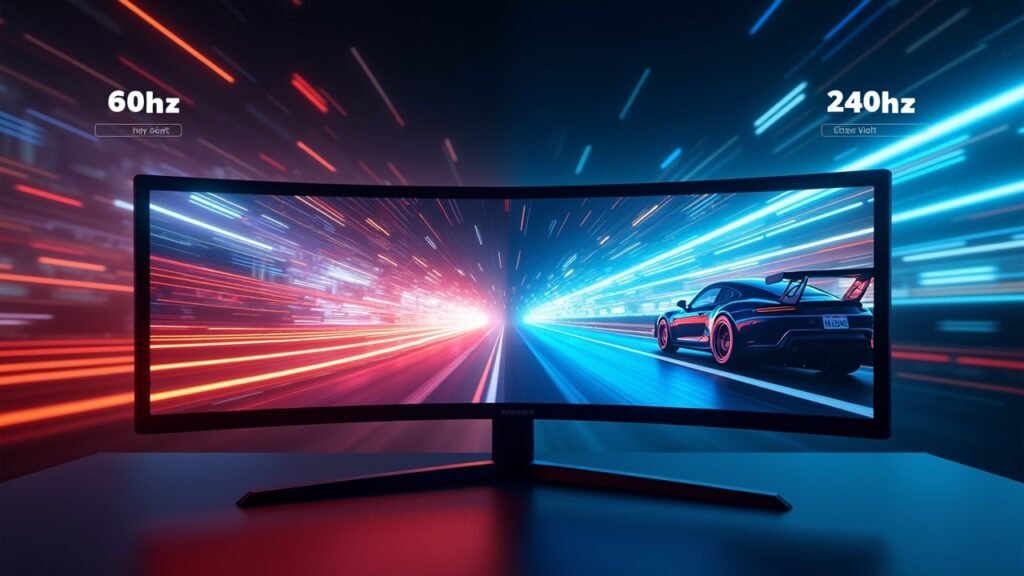
Okay, let me break this down real quick. The refresh rate is basically how many times per second your monitor updates the image on screen. A 144Hz monitor refreshes 144 times per second, while a 240Hz does it 240 times. Simple math, right?
Here’s where I made my first mistake though – I thought refresh rate and frame rate were the same thing. They’re not! Your graphics card produces frames (FPS), and your monitor displays them at its refresh rate. If your GPU only pumps out 100 FPS, that fancy 240Hz monitor won’t magically make things smoother beyond what your system can actually deliver.
I learned this the hard way when I first got my 240Hz panel and was still running a GTX 1060. Yeah, that was dumb.
The 144Hz Sweet Spot (And Why Most People Should Probably Stop Here)
Let’s be real – 144Hz monitors are incredible. When I first upgraded from a standard 60Hz display to 144Hz back in 2020, it literally felt like I’d been gaming with a blindfold on for years. Everything became buttery smooth, responsive, and way more enjoyable.
For competitive gaming in titles like Apex Legends or Warzone, 144Hz gives you a massive advantage over 60Hz players. Your reaction times improve because you’re seeing updated information more than twice as fast. Motion blur decreases significantly, and tracking moving targets becomes way easier.
Plus, 144Hz monitors are way more affordable now. You can snag a decent 144Hz gaming monitor for around $200-300, which makes it accessible for most gamers with reasonable budgets.
Making the Jump to 240Hz (My Expensive Experiment)
Now we’re talking about the premium tier. 240Hz monitors typically start around $400 and can shoot up to $700+ depending on features like panel type, resolution, and all that jazz.
When I first fired up my 240Hz monitor, I’ll admit something embarrassing – I couldn’t really tell the difference right away. I was playing Valorant, squinting at the screen, moving my mouse around like an idiot trying to “feel” the extra frames. My buddy online was laughing at me the whole time because I kept asking “does this look smoother to you?”
But then something clicked after about a week. The difference between 144Hz and 240Hz is way more subtle than 60Hz to 144Hz, but it’s definitely there. It’s like… imagine the difference between smooth and extra smooth peanut butter. Both are smooth, but one just has that slightly different feel.
Where 240Hz Actually Matters
Here’s what I’ve noticed after extensive testing (and way too many hours of gaming when I should’ve been doing literally anything else):
- Fast-paced FPS games: In competitive shooters like Valorant, CS2, or Overwatch 2, that extra refresh rate can make micro-adjustments feel more precise.
- Esports scenarios: If you’re seriously competing at high ranks, every millisecond counts, and 240Hz reduces input lag even further.
- Motion clarity: Fast horizontal movements across your screen appear noticeably clearer on 240Hz compared to 144Hz.
However – and this is important – you absolutely NEED a powerful GPU to actually benefit from 240Hz. I’m talking RTX 4070 or better for modern games at 1080p. Otherwise you’re basically wasting money on hardware your system can’t fully utilize.
The Honest Truth About Diminishing Returns
Let me hit you with some real talk that might save you some cash. The jump from 144Hz to 240Hz provides maybe 30-40% of the perceived improvement you got going from 60Hz to 144Hz. Most casual gamers won’t notice enough difference to justify the price premium.
I’ve actually had friends come over to test both my monitors in blind comparisons, and about half couldn’t consistently identify which was which. That was a bit of a gut punch considering what I’d spent!
Professional gamers and esports athletes? Yeah, they’ll benefit from 240Hz. But if you’re playing single-player RPGs, strategy games, or anything that isn’t hyper-competitive, 144Hz is genuinely plenty. I still use my old 144Hz panel as a secondary monitor and honestly forget it’s not 240Hz most of the time.
My Recommendation Based on Real Experience
Choose 144Hz if you’re on a budget, play a variety of game genres, or don’t compete at high levels. It’s the best bang for your buck in 2026, hands down.
Go for 240Hz if you’re serious about competitive gaming, have the GPU power to support it (consistently hitting 200+ FPS), and can comfortably afford the extra investment without stressing about it.
And honestly? Don’t feel pressured by what streamers or YouTubers say. They often get this stuff for free or as sponsorships. Your gaming experience won’t be ruined by “only” having 144Hz – trust me on that one.
What I’d Do Differently Knowing What I Know Now
If I could go back and advise my past self? I probably would’ve stuck with 144Hz and invested that extra $300 into a better graphics card instead. The performance gains from a GPU upgrade would’ve been way more noticeable across ALL my games, not just competitive shooters.
That said, I don’t regret my 240Hz purchase entirely. It’s nice having that extra smoothness in Valorant ranked matches, and yeah, there’s definitely something cool about having top-tier hardware even if it’s a bit overkill for my skill level!
The refresh rate wars will probably keep going – we’re already seeing 360Hz and even 500Hz monitors hit the market. But there’s absolutely a point where human perception just can’t keep up with the technology. For most of us, that ceiling is somewhere between 144Hz and 240Hz.
Whatever you decide, make sure it fits YOUR needs and YOUR budget. Gaming should be fun, not financially stressful. And if you’re hungry for more honest takes on gaming gear and tech, swing by Voltzora where we keep things real and actually test stuff before telling you what to buy!